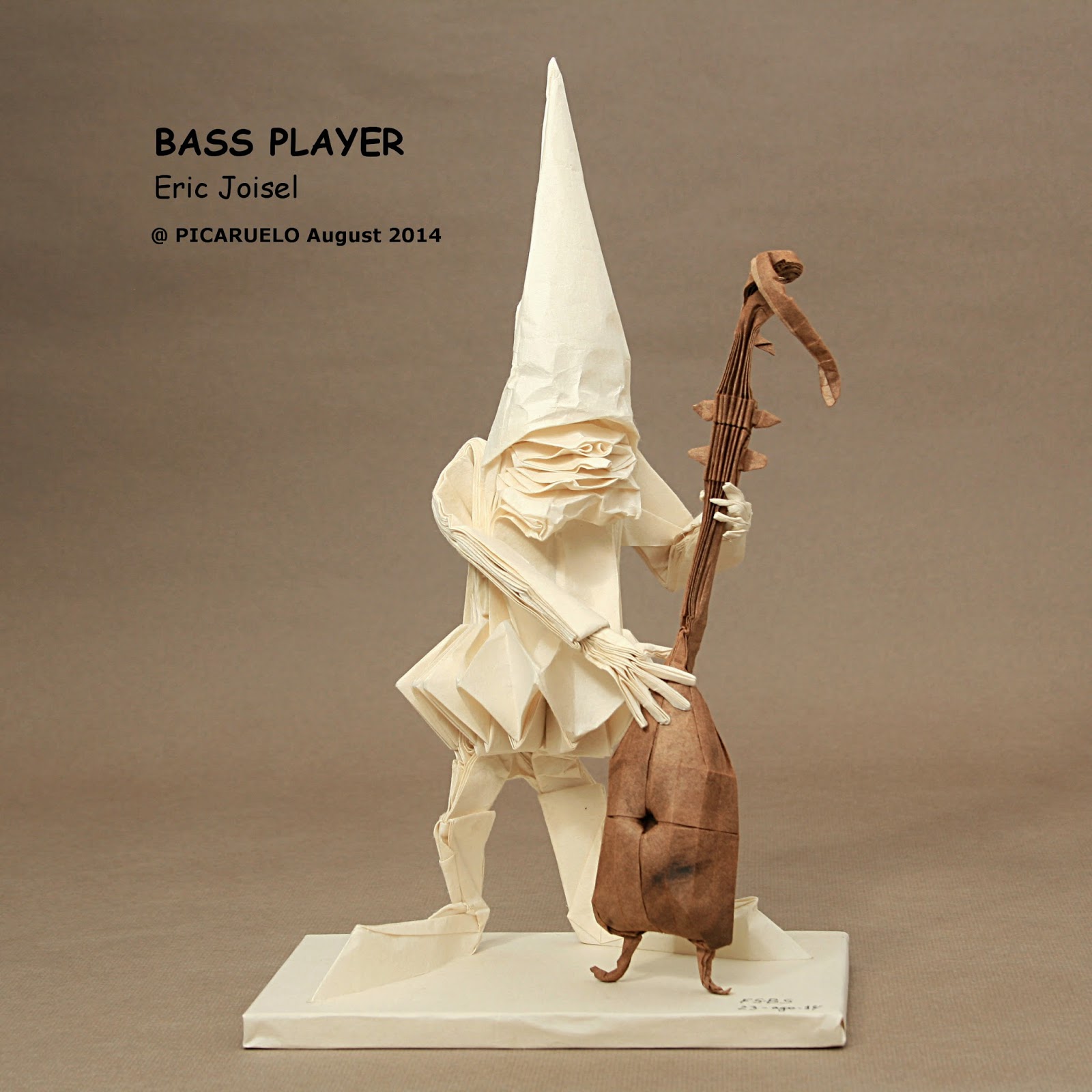
And here you have Joisel's bass player in the Zaragoza Exhibition in 2013:
 |
| Joisel's bass player in the Zaragoza Exhibition in 2013 |

In this case I have used a slightly bigger paper, the maximum I could get from the piece of Kozo paper I had: 64x64cm. The total height of the model is 27 cm. I have used a long vertical hat to make it as tall as possible so that it looks over the instrument. Compared to the violinist the model is much more slender. Together with the long hat, I used long legs. Note how I used smaller feet than in the violinist and no knees at all to lengthen the legs. They are small details that make two similar models look very different.
The instrument, a bass, is difficult to classify. A bass may refer to different instruments, none of them exactly the same as the origami model I have folded. However, the similarities with Joisel's bass and the beauty of the model made me select it for my musician.
In the following images from Wikipedia you can see some of the instruments that are called basses. I like to imagine the origami model like a mixture between the bass violin or cello and the acoustic bass guitar:
The instrument, a bass, is difficult to classify. A bass may refer to different instruments, none of them exactly the same as the origami model I have folded. However, the similarities with Joisel's bass and the beauty of the model made me select it for my musician.
In the following images from Wikipedia you can see some of the instruments that are called basses. I like to imagine the origami model like a mixture between the bass violin or cello and the acoustic bass guitar:
 |
| Acoustic bass guitar |
 |
| Bass guitar |
 |
| Bass violin |
In the origami world there have already been several bass designs. I have found three related to Joisel's model:
The first one, with very little documentation appears in the Spanish Origami Association (AEP) forum:
 |
| Photograph published by 'zenutrio' in the AEP forum |
 |
| CP draft showing the bass body (it doesn't appear in the forum any more but I think it matches the previous model) |

And the third one, my option, has been designed and published by Alexander Kurth. Alexander is a very talented young german origami artist. Here are some links to his flickr, Facebook and Youtube channel. Enjoy his creations. In his Youtube channel he has a videodiagram showing step by step how to fold the bass:
I have drawn his bass CP to illustrate the design:

It is a 3x1 box pleating design. It uses a 48x16 grid. The body is on the left and the arm on the right. I folded my model from a 41x13.3 cm kozo paper painted with brown water colour. The most beautiful part of this model is probably the central hole in the body. You can see the detail in the model I folded:
 |
| Back |
 |
| Front |
The only problem I found in Alexander's model was that it is back opened. As I have explained in other posts, my idea when folding these musicians was to make them completely three dimensional. Until now I had succeeded in all the models except in the violin that has an open back. However Alex's bass is relatively easy to close. As you can see in the upper photograph, the sides of the body have several layer of paper. It is simple to unfold and stretch them to form the flat back of the instrument. The only drawback is that the process shortens the legs but, who cares how long are those legs?
Let us see several pics of the process:
Let us see several pics of the process:


And the model is completely closed:


Finally, I show a few photographs of the model from different points of view:
 |
| Face detail |