Showing posts with label hobbit. Show all posts

Saturday, 25 October 2014

THE BASS PLAYER

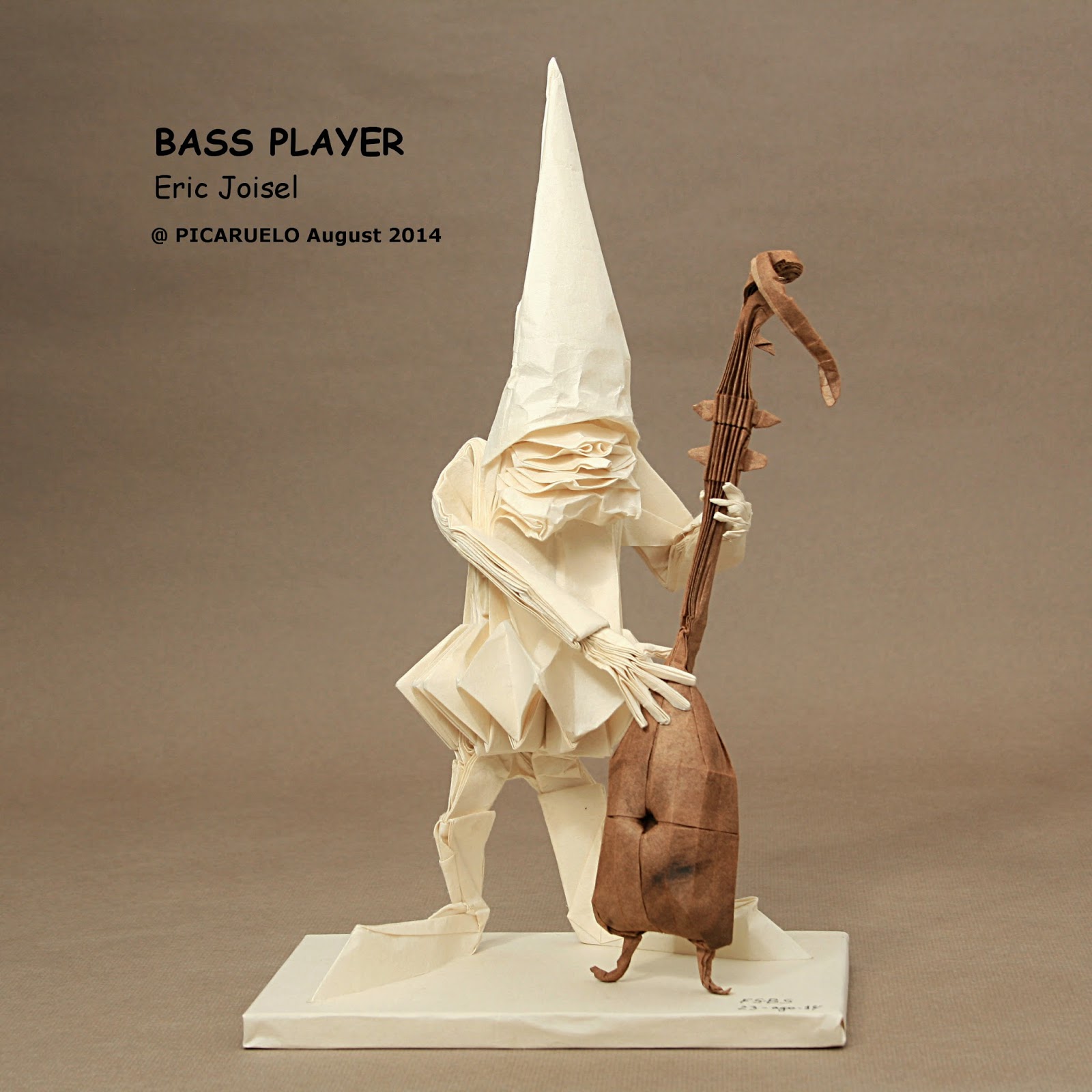
The seventh dwarf in my Music Band is the tallest with his very long hat. Besides, he has the biggest instrument until now. He is standing straight, gently touching the bass strings. He is here:

And here you have Joisel's bass player in the Zaragoza Exhibition in 2013:
Joisel's bass player in the Zaragoza Exhibition in 2013
The model is folded from the same base than the violinist that I already presented in this blog, the dwarf with diamonds:

In this case I have used a slightly bigger paper, the maximum I could get from the piece of Kozo paper I had: 64x64cm. The total height of the model is 27 cm. I have used a long vertical hat to make it as tall as possible so that it looks over the instrument. Compared to the violinist the model is much more slender. Together with the long hat, I used long legs. Note how I used smaller feet than in the violinist and no knees at all to lengthen the legs. They are small details that make two similar models look very different.

The instrument, a bass, is difficult to classify. A bass may refer to different instruments, none of them exactly the same as the origami model I have folded. However, the similarities with Joisel's bass and the beauty of the model made me select it for my musician.

In the following images from Wikipedia you can see some of the instruments that are called basses. I like to imagine the origami model like a mixture between the bass violin or cello and the acoustic bass guitar:

Acoustic bass guitar

Bass guitar
Bass violin

In the origami world there have already been several bass designs. I have found three related to Joisel's model:

The first one, with very little documentation appears in the Spanish Origami Association (AEP) forum:
Photograph published by 'zenutrio' in the AEP forum

CP draft showing the bass body (it doesn't appear in the forum any more but I think it matches the previous model)
The second one is the model designed and released by Ricardo Montecinos in his flickr page:
And the third one, my option, has been designed and published by Alexander Kurth. Alexander is a very talented young german origami artist. Here are some links to his flickr,  Facebook and Youtube channel. Enjoy his creations. In his Youtube channel he has a videodiagram showing step by step how to fold the bass:


I have drawn his bass CP to illustrate the design:


It is a 3x1 box pleating design. It uses a 48x16 grid. The body is on the left and the arm on the right. I folded my model from a 41x13.3 cm kozo paper painted with brown water colour. The most beautiful part of this model is probably the central hole in the body. You can see the detail in the model I folded:

Back
Front
The only problem I found in Alexander's model was that it is back opened. As I have explained in other posts, my idea when folding these musicians was to make them completely three dimensional. Until now I had succeeded in all the models except in the violin that has an open back. However Alex's bass is relatively easy to close. As you can see in the upper photograph, the sides of the body have several layer of paper. It is simple to unfold and stretch them to form the flat back of the instrument. The only drawback is that the process shortens the legs but, who cares how long are those legs?

Let us see several pics of the process: 


And the model is completely closed:


Finally, I show a few photographs of the model from different points of view:

Face detail


Thursday, 31 July 2014

THE FLAUTIST

This post could well have been titled 'The Pied Piper of Hamelin' because the end result of my next musician reminds me of that personage. The idea came to my mind step by step as I folded the complete model. First the musician, then the instrument, a transverse flute silver coloured with little contrast and finally the rat to give it more colour and to emulate the Hamelin tale. Let us see the whole story:

After the first three musicians I wanted to fold something different. For a long time I had been thinking about folding one of the Joisel's long and thin musicians. It was going to be different to the other dwarves but if I folded it with the right proportions I thought I could mix them. The photograph that inspired me can be found in Joisel's web page:

The models are taller and thinner than the dwarves in the Jazz Band but they have the same structure. There is one thing that caught my attention. It is the neck that some of the models show. I have not found a solution to this problem yet. Until now, none of the musicians I have folded has a proper neck.

After long hours of investigation, documentation, folding and modelling I came up with my fourth musician: THE FLAUTIST. He is accompanied by a rat, of course a Joisel's rat, that stands hypnotised by the music as if in the tale 'The Pied Piper of Hamelin'.


As always, the first step is getting a good design. I was lucky and I found a CP by Edwin Claudio from the Sociedad Boliviana de Origami (Origami Bolivian Society). The origami coming from Bolivia is astonishing. 

The CP has the same structure as the 'tradicional' Joisel's dwarf but coming from a rectangle instead of a square. The grid is 40x32. The result is a very harmonious and stylised model with very long and thin legs. In my case I used a Kozo rectangle of 40x32 cm, 1cm per division. The end height of the model is 23,5 cm. As in the dwarves the arms come out from behind the head. There is a little trick that helps to lengthen the arms and makes them begin from a lower position. We'll see it later.

After seeing this CP you can think about some obvious variations. You can modify it to fold the Jobit with diamonds, skirt or the Jobit dressed on a tailcoat. I may try them in future musicians.

Let us see the collapsing process:

Precreased CP. The folds at the lower part of the body are very slightly creased. It is better to make them later once the model is almost totally collapsed. Depending on how you close the body, they can be in a slightly different position 

I start the collapsing process with the legs

Then I close the upper part

And I end closing the lower part of the coat/body You can see how the arms come out from behind the head.

The final base, front view
Back view
Depending on how we have collapsed the bottom of the coat we can have more or less excess paper. We hide it inside the body using a squash fold trying to make the legs as long as possible.  

The lower part of the body before hiding it with a squash fold 
Once hidden, the legs are much longer
From this stage the folding process is very similar to the 'tradicional' dwarf's one.

We fold the legs to hide them behind the body

The legs coming out from inside the body.

Back view. Now we only have to close the model using the extra paper in the two sides of the back and hiding one of them inside the pocket formed by the other one as in the 'tradicional' dwarf. 

Back view once the model is closed

Front view 
Finally, in order to get a more natural pose for the arms we pull them down while pushing back the hat. The drawback of this process is that we can not make the hat go straight up from the head as before. In my case it wasn't a problem because I wanted to make a cap. A long, pointed hat would have made the contrast with the other dwarves bigger than I pretended.

Lowering the hat while pulling down the arms
After this step, the modelling process starts. You have to be careful reinforcing the legs (in my case with methylcellulose and carpenter glue). They are thin and may not hold the model if not properly treated.

We come up with the end model that I show from different sides:


The instrument, a transverse flute, is folded from a 74x12 rectangle. The CP was deduced and released by Ricardo Montecinos in his web page.
Now you can see some pics on how to collapse the keys (a total of nine) and the mouthpiece. 
The draft I made to calculate the position of each line of the CP
Collapsing one key
A view of  two keys nearly collapsed
Collapsing the mouthpiece
The collapsed mouthpiece
Final collapsed model, the mouthpiece on the left and two keys on the right
Back view
This simple test fold let me learn how the CP worked and I could start the definitive flute. It is folded from a 23.9 x 3.9 cm kozo paper rectangle painted with silver acrylic. Once you fold the keys and mouthpiece you only have to form a cylinder with the remaining paper and close both ends with some paper. This is the end result:


And finally, some words about one of the best origami designs ever, at least in my humble opinion, Joisel's rat. It was designed by Eric Joisel in 1996 and has been published in many books and magazines, for example in the great book 'Eric Joisel - The Magician of Origami'.


Here is a close up pic of the rat: